Building a Quantum-Ready Workforce: Professional Skills, Training Paths and Career Development
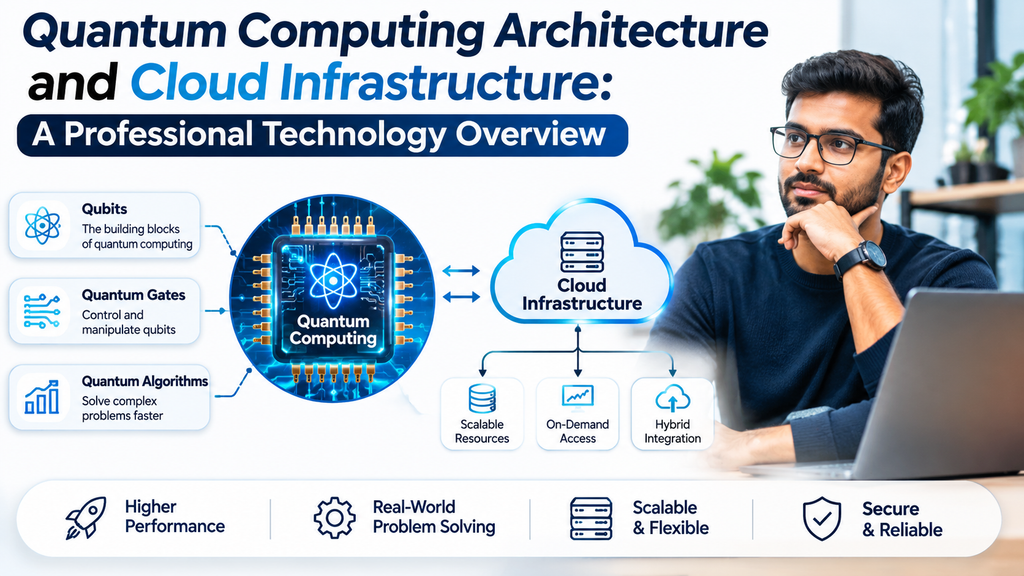
1. Introduction: Why Professionals Should Understand Quantum Computing
Technology professionals regularly face new tools, programming methods, and infrastructure changes. Quantum computing represents another area worth understanding.
It uses principles from quantum physics to process information in ways that differ from classical computing. Researchers are exploring applications in optimisation, chemistry, materials science, simulation, and other specialised fields.
However, quantum computing is not a replacement for traditional software development. Classical computers remain essential for most everyday applications.
The growing research activity creates a need for professionals who understand quantum concepts and can work with related software and cloud platforms.
Different roles need different skills. A software engineer may focus on programming. A cloud engineer may study remote execution environments. A researcher may explore algorithms. An IT manager may evaluate technical opportunities and investment requirements.
This guide explains how professionals can build relevant skills, choose training paths, complete practical projects, and prepare for technical responsibilities.
2. Understand the Skills Required for Quantum Computing
Before choosing a training programme, identify the skills needed for your target role.
Quantum computing combines mathematics, programming, computer science, and quantum physics. Learners do not need to master every subject immediately.
2.1 Mathematical foundations
Mathematics helps learners understand how quantum states and operations work.
Focus on:
- Linear algebra.
- Vectors and matrices.
- Complex numbers.
- Probability.
- Basic mathematical functions.
- Matrix operations.
These subjects support the study of quantum states, gates, and measurement.
2.2 Programming knowledge
Python provides a practical starting point for many quantum programming exercises.
Learn variables, functions, loops, classes, modules, and package management.
You should also understand how to organise projects, handle errors, and work with external libraries.
2.3 Computer science fundamentals
Study algorithms, data structures, computational complexity, and software testing.
These subjects help developers understand the difference between classical and quantum approaches.
2.4 Quantum concepts
Learn qubits, superposition, entanglement, quantum gates, circuits, and measurement.
Try to understand each concept through small examples rather than memorising definitions.
2.5 Cloud and infrastructure knowledge
Quantum experiments may run through remote platforms.
Knowledge of cloud services, authentication, permissions, job execution, and resource management can help technical professionals work with these environments.
3. Quantum Cloud Computing Training
Quantum cloud computing training helps professionals access quantum development environments without managing specialised hardware themselves.
It is useful for learners who want to combine programming knowledge with practical experiments.
3.1 Learn the cloud development process
Start by understanding how a cloud-based quantum experiment works.
A typical process includes:
- Preparing a quantum circuit.
- Selecting a simulator or supported device.
- Submitting the experiment.
- Monitoring execution.
- Collecting measurement results.
- Reviewing the output.
Learn what happens at each stage.
3.2 Practise with simulators
Use a simulator for your first experiments.
Create a small circuit and study its measurement distribution. Change the gate sequence and observe how the output changes.
This provides a practical introduction to quantum circuit behaviour.
3.3 Explore physical hardware carefully
After learning simulation, investigate available quantum hardware.
Check the supported gates, connectivity, and execution requirements before submitting a circuit.
Physical devices may produce different results because of noise and other hardware limitations.
3.4 Develop a cloud project portfolio
Create separate folders for circuit code, configurations, experiment results, and notes.
Record the execution environment and software versions.
Practical project: Build a small collection of cloud-based experiments that demonstrates circuit creation, execution, and result analysis.
4. Quantum Computing Certification Course
A quantum computing certification course can provide a structured learning path for people entering this field.
It can help learners understand important concepts and organise their practical development.
However, the value of a course depends on its content and assessment quality.
4.1 Choose the right course level
A beginner should start with quantum fundamentals and basic mathematics.
A developer with programming experience may prefer circuit development and algorithm implementation.
A researcher may need deeper mathematical and theoretical coverage.
4.2 Check the syllabus
Review whether the programme covers:
- Quantum computing fundamentals.
- Quantum states and gates.
- Circuit development.
- Quantum algorithms.
- Programming frameworks.
- Simulation exercises.
- Cloud-based experiments.
- Practical assignments.
The syllabus should match your learning objective.
4.3 Look for project-based assessments
Practical assessments help learners apply what they study.
For example, an assignment could require building a circuit, executing it on a simulator, and explaining its measurement results.
Save completed assignments as part of your learning portfolio.
4.4 Verify certificate recognition
Check the issuing organisation and its assessment process.
Do not assume that every training certificate is an accredited academic or professional qualification.
Practical project: Complete a course assignment and prepare a short technical report explaining the circuit and its output.
5. QuantumOps Certification
QuantumOps certification may refer to a particular branded programme related to quantum computing skills or operations.
Its exact curriculum and recognition depend on the issuing organisation. Check the credential details before relying on claims about industry-wide acceptance.
For career development, operational knowledge can help professionals understand how quantum experiments are prepared, executed, and maintained.
5.1 Understand quantum workflow operations
Learn how to manage:
- Development environments.
- Programming dependencies.
- Circuit configurations.
- Backend selection.
- Experiment execution.
- Job status.
- Measurement results.
- Execution failures.
These activities support reliable technical work.
5.2 Practise troubleshooting
Suppose a circuit runs successfully in a simulator but fails on a selected device.
Check whether the backend supports the required operations. Review the transpiled circuit and inspect the execution error.
Record the problem and the corrective action.
5.3 Learn experiment documentation
Every important experiment should have a clear record.
Include the source code version, execution settings, backend, input data, and output.
This makes it easier for another team member to understand the work.
5.4 Prepare an operational portfolio
Create a small runbook that explains environment setup, execution, common failures, and recovery procedures.
Practical project: Document a quantum experiment from initial setup through successful execution and troubleshooting.
6. Qiskit Programming Course
A Qiskit programming course can help developers learn how to construct, simulate, and execute quantum circuits.
It is a useful option for programmers who want practical experience with quantum software development.
6.1 Learn the programming structure
Start with the basic components of a quantum circuit.
Understand how to create qubits, apply gates, add measurements, and inspect circuit information.
Practise with small examples before attempting larger algorithms.
6.2 Explore quantum gates
Study common gates such as:
- Hadamard.
- Pauli-X.
- Pauli-Y.
- Pauli-Z.
- CNOT.
- Controlled operations.
Understand how each gate changes the quantum state.
6.3 Build simple circuits
Create a circuit that applies a Hadamard gate to an initial zero state.
Measure the qubit repeatedly using an ideal simulator. The outcomes should approach an even distribution between zero and one.
Next, create a two-qubit Bell state. Apply a Hadamard gate to the first qubit, followed by a CNOT operation.
Under ideal measurement, the results should show correlated outcomes.
6.4 Understand transpilation
A circuit may need modification before execution on a specific backend.
A transpiler can adapt the circuit to the target device’s supported gates and connectivity.
Inspect the transpiled output to understand how the circuit changes.
6.5 Create a programming portfolio
Store your circuits in version control.
Include project descriptions, source code, test results, and explanations.
Practical project: Build a small Qiskit repository containing basic gates, superposition, entanglement, and measurement examples.
7. AWS Braket Training
AWS Braket training introduces professionals to a managed environment for quantum computing experiments.
It can be useful for developers and cloud engineers who want to understand quantum execution through cloud services.
7.1 Understand the platform workflow
Study how to prepare circuits, select execution targets, submit tasks, and retrieve results.
Understand the differences between simulators and supported quantum devices.
7.2 Practise circuit execution
Start with a small circuit.
Execute it using a suitable simulator and review the measurement output.
After understanding the experiment, check whether a supported hardware device can run it.
7.3 Learn cloud resource management
Cloud experiments may involve charges based on selected services and resources.
Review current pricing and service conditions before running repeated experiments.
Keep track of execution volume and resource consumption.
7.4 Connect quantum knowledge with cloud skills
Cloud engineers can use their existing knowledge of access management, permissions, resource planning, and automation.
They should also learn the specific execution requirements of the selected quantum platform.
Practical project: Prepare a small cloud experiment and document its circuit, execution target, output, and resource requirements.
8. Quantum Computing for Software Engineers
Quantum computing for software engineers focuses on using existing development skills to build quantum-enabled applications.
Developers do not need to abandon classical programming. Instead, they learn how quantum components can work alongside traditional software.
8.1 Build on existing programming experience
Python knowledge provides a useful starting point.
Developers should understand functions, modules, classes, package management, debugging, and version control.
These skills support quantum application development.
8.2 Understand application integration
A quantum application may contain several components.
For example:
- A user interface collects input.
- A classical service validates the data.
- A processing module prepares the problem.
- A quantum module creates a circuit.
- An execution service submits the experiment.
- A result module processes the output.
Each component should have a clear responsibility.
8.3 Apply software engineering practices
Use modular code and meaningful function names.
Keep configuration separate from application logic.
Write tests for input handling, circuit creation, and result processing.
Handle failed jobs and unavailable services carefully.
8.4 Build an application prototype
Create a small application that accepts input and runs a quantum experiment.
Display the resulting measurements in a readable format.
Explain what the output means and what limitations apply.
Practical project: Develop a simple quantum circuit application with input validation, execution handling, and result reporting.
9. Quantum Computing Architecture Course
A quantum computing architecture course helps professionals understand how quantum components fit into complete technical systems.
This knowledge is useful for architects, senior developers, cloud engineers, and technical leads.
9.1 Study the main architecture components
A quantum-enabled system may include:
- Application interfaces.
- Classical application services.
- Data preparation modules.
- Quantum circuit components.
- Cloud execution services.
- Simulators and hardware.
- Result processing.
- Storage and reporting.
Learn how these components communicate.
9.2 Understand system data flow
Create an architecture diagram showing how information moves through the application.
Identify where input is received, how a circuit is prepared, where execution takes place, and how results return.
9.3 Consider system requirements
Architecture design should include security, reliability, maintainability, and cost considerations.
Document access permissions and protect credentials.
Define what happens when an execution service becomes unavailable.
9.4 Prepare architecture documentation
Describe each component and its responsibilities.
Include interfaces, dependencies, execution flows, and important limitations.
Practical project: Design an architecture diagram for an application that combines classical processing with a quantum execution service.
10. Hybrid Quantum Classical Computing Training
Hybrid quantum classical computing training teaches professionals how to combine classical processing with quantum execution.
This is important because many experimental quantum algorithms depend on both computing models.
10.1 Understand the hybrid workflow
A typical hybrid process may include:
- Preparing input data.
- Selecting initial circuit parameters.
- Building a parameterised circuit.
- Executing the circuit.
- Collecting measurements.
- Calculating an objective value.
- Updating parameters.
- Repeating the process.
Variational quantum algorithms provide examples of this approach.
10.2 Learn classical optimisation
Understand how classical optimisers update parameters.
Study how the objective function responds to different parameter values.
This knowledge helps developers understand the relationship between classical and quantum components.
10.3 Track execution behaviour
Record the number of iterations, circuit evaluations, objective values, and execution time.
Also, measure the complete workflow rather than looking only at quantum circuit execution.
10.4 Compare with classical methods
Use a suitable classical baseline.
Compare solution quality and resource requirements under consistent conditions.
Do not assume that combining quantum and classical computing automatically creates an advantage.
Practical project: Build a small hybrid experiment and document how its classical optimiser interacts with a parameterised quantum circuit.
11. Quantum Computing Consulting Services
Quantum computing consulting services can help organisations and professionals understand technical opportunities and plan suitable experiments.
Consultants may support training assessments, architecture planning, algorithm selection, and proof-of-concept development.
11.1 Understand the organisation’s needs
Begin by discussing the business or research problem.
Identify the current process, technical challenges, available data, and expected outcome.
11.2 Review employee skills
Assess the team’s existing programming, mathematics, cloud, and research knowledge.
Identify the skills needed for the proposed project.
This helps the organisation select suitable training.
11.3 Recommend a learning and project plan
Create a plan that connects training with practical activities.
For example, developers may begin with circuit programming. Cloud engineers may explore remote execution. Managers may study project evaluation and architecture.
11.4 Support a proof of concept
Choose a small experiment with clear objectives.
Define the algorithm, tools, test conditions, and evaluation criteria.
After testing, document the findings and limitations.
Practical project: Prepare a technical skills assessment and a learning plan for a small quantum computing team.
12. Quantum Computing for IT Managers
Quantum computing for IT managers focuses on workforce planning, technical evaluation, project governance, and resource management.
Managers do not need to write every quantum circuit. They need enough understanding to guide the people and resources involved.
12.1 Identify the required roles
A quantum computing initiative may involve:
- Quantum researchers.
- Software developers.
- Cloud engineers.
- Data specialists.
- Solution architects.
- Technical project managers.
The exact team depends on the project scope.
12.2 Create role-based learning plans
Different roles need different learning objectives.
| Role | Recommended learning focus |
|---|---|
| Software developer | Python, circuits, Qiskit, testing |
| Cloud engineer | Cloud execution, permissions, resource management |
| Researcher | Mathematics, algorithms, experiments |
| Solution architect | System design, integration, data flow |
| IT manager | Planning, budgets, governance, evaluation |
This prevents organisations from assigning identical training to every employee.
12.3 Establish project controls
Set rules for cloud access, training budgets, approved tools, and experiment documentation.
Assign responsibility for technical reviews and resource approvals.
12.4 Measure employee progress
Evaluate practical work rather than relying only on course completion.
Review projects, code, experiment reports, and the ability to explain technical decisions.
Practical project: Create a workforce development plan with role-based skills, training activities, and project milestones.
13. A Practical Learning Roadmap for Beginners
A structured learning roadmap can help beginners avoid jumping between unrelated tools.
The following sequence provides a foundation.
13.1 Stage One: Learn the fundamentals
Study qubits, superposition, entanglement, gates, and measurement.
Review basic linear algebra and probability.
Your target is to explain the main concepts in simple language.
13.2 Stage Two: Develop programming skills
Learn Python and practise writing small programs.
Understand functions, modules, packages, debugging, and version control.
Your target is to write and maintain simple Python projects.
13.3 Stage Three: Start quantum programming
Choose a programming framework and build simple circuits.
Study how gates change quantum states.
Your target is to create and simulate basic circuits.
13.4 Stage Four: Explore cloud environments
Learn how to execute experiments through a cloud platform.
Understand simulator selection, task submission, and result collection.
Your target is to complete and document a cloud-based experiment.
13.5 Stage Five: Build a practical project
Choose a small problem and investigate a suitable quantum approach.
Create a classical baseline and compare the results.
Your target is to produce a clear technical report.
13.6 Stage Six: Develop a professional portfolio
Organise source code, experiment records, architecture diagrams, and project explanations.
Your target is to demonstrate what you have learned through practical evidence.
14. How to Prepare for Quantum Computing Career Opportunities
Career preparation should focus on skills and evidence rather than certificates alone.
14.1 Choose a technical direction
Possible directions include:
Quantum software development: Focus on programming frameworks, circuits, algorithms, and software integration.
Quantum research: Focus on mathematics, algorithms, scientific methods, and experimental analysis.
Quantum cloud engineering: Study cloud execution, resource management, permissions, and automation.
Quantum architecture: Learn system integration, interfaces, data flow, and reliability.
Quantum technology management: Develop technical evaluation, workforce planning, and project governance skills.
14.2 Build relevant projects
Complete projects that match your target role.
A software developer can build a circuit application. A cloud engineer can document an execution workflow. A researcher can investigate measurement noise.
14.3 Prepare technical explanations
Practise explaining what your project does.
Describe the problem, algorithm, tools, testing method, and results.
Be honest about limitations and areas you still need to learn.
14.4 Continue learning
Quantum computing is an active research area.
Follow changes in programming frameworks, cloud services, hardware capabilities, and algorithms.
Review new material critically rather than assuming every announcement represents a practical breakthrough.
15. Common Mistakes When Learning Quantum Computing
15.1 Starting with advanced algorithms
Advanced algorithms can become difficult without basic mathematical knowledge.
Build the foundations first.
15.2 Learning tools without understanding concepts
Knowing programming commands is not enough.
Understand why a circuit uses particular gates and what its output represents.
15.3 Collecting certificates without projects
Certificates can support learning, but practical projects demonstrate how you apply knowledge.
Build a portfolio alongside your training.
15.4 Ignoring classical computing skills
Quantum applications still depend on classical programming, data processing, and software engineering.
Keep developing these skills.
15.5 Expecting immediate job opportunities
A training programme cannot guarantee employment.
Develop practical ability, communicate your work clearly, and understand the requirements of the roles you target.
15.6 Treating every quantum application as production-ready
Many applications remain experimental.
Understand the limitations of available hardware and the evidence behind performance claims.
16. Frequently Asked Questions
16.1 What is quantum cloud computing training?
It teaches learners to develop and execute quantum experiments through cloud-based simulators and supported hardware. It can include circuit development, task execution, and result analysis.
16.2 Is a quantum computing certification course suitable for beginners?
Yes, if it starts with the necessary mathematical and quantum foundations. Beginners should choose a programme with clear explanations and practical exercises.
16.3 What is QuantumOps certification?
It may refer to a specific branded training or credential programme related to quantum computing operations. Verify its syllabus, issuer, and assessment process.
16.4 Why should developers take a Qiskit programming course?
It helps developers understand circuit construction, gates, simulation, measurement, and execution using a practical quantum programming framework.
16.5 What skills can AWS Braket training provide?
It can introduce cloud-based quantum experiments, simulator usage, supported hardware, task execution, and resource planning.
16.6 Can traditional software engineers enter quantum computing?
Yes. Their programming and software engineering experience provides a useful foundation. They will need additional knowledge of quantum concepts and programming methods.
16.7 What is the purpose of a quantum computing architecture course?
It teaches how classical applications, quantum software, cloud services, and execution environments connect within a complete system.
16.8 What is hybrid quantum classical computing training?
It teaches how classical processing and quantum execution work together in experimental algorithms and applications.
16.9 When should an organisation use quantum computing consulting services?
Consulting can help an organisation assess employee skills, select suitable training, evaluate use cases, and plan technical experiments.
16.10 Why should IT managers understand quantum computing?
It helps them evaluate proposals, identify training needs, manage resources, guide technical teams, and set realistic project expectations.
17. Final Thoughts
Building a quantum-ready workforce requires a clear learning strategy.
Professionals should begin with mathematical and programming foundations. They can then explore quantum circuits, cloud platforms, architecture, and hybrid computing.
The most useful learning path depends on the person’s role. Developers need practical programming experience. Researchers need strong mathematical understanding. Cloud engineers need platform and execution knowledge. Managers need technical awareness and project evaluation skills.
Training provides structure, but practical work builds confidence. Complete small experiments, document the results, and explain what you learned.
A well-organised portfolio can show your progress and help others understand your technical abilities. Focus on genuine skills, realistic expectations, and continuous learning.